
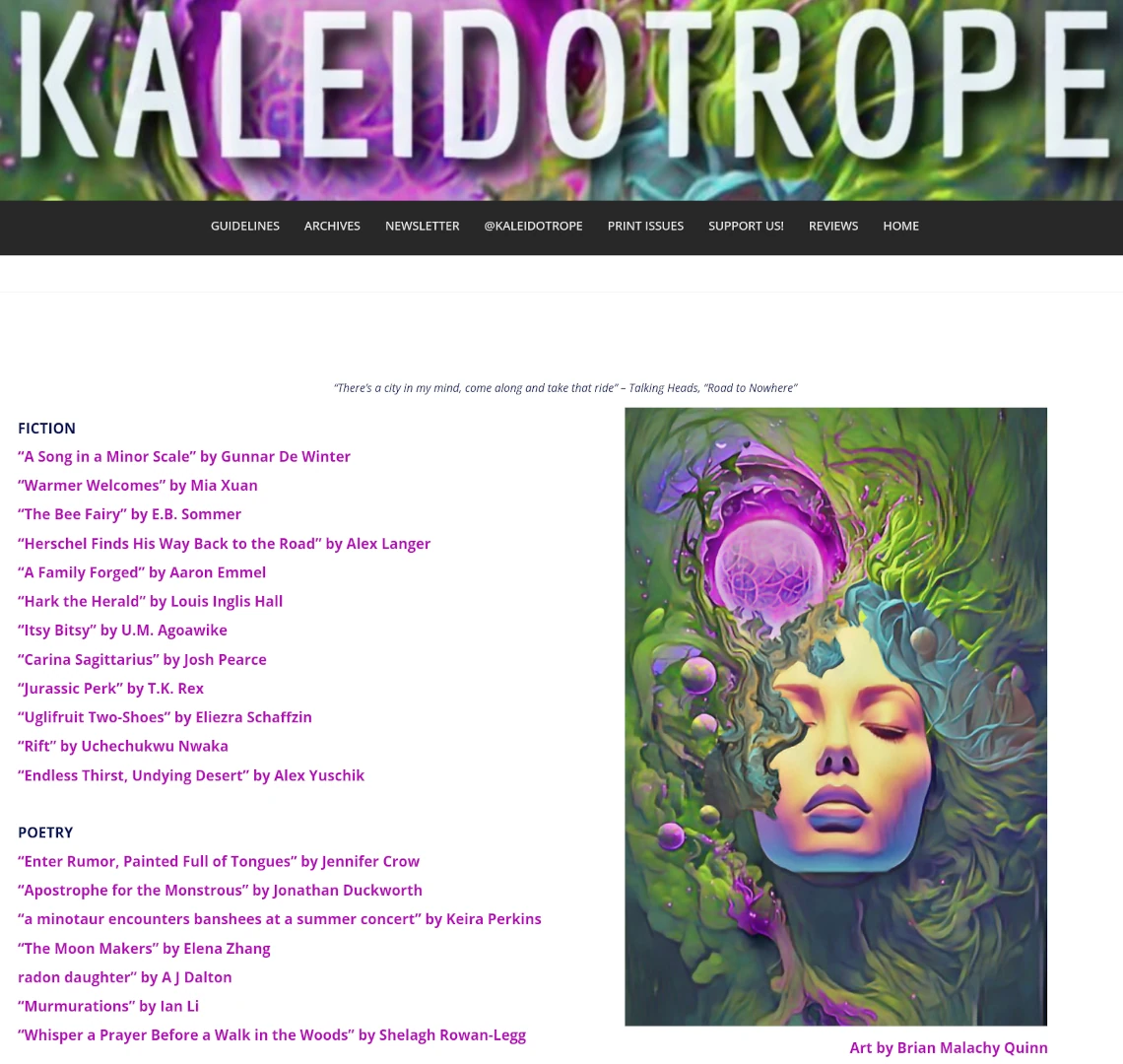
This article is part of my Recommended Reading profile series, originally written and posted 1-Sept-2026.
Summary
Kaleidotrope reads at times like a fable, a dream, a prediction. Each issue generates a consistent sense of wonder and surprise. I think if independent speculative fiction were a small town, this would be the town square.
Find it at: Kaleidotrope.
- Genres: Eclectic across speculative fiction: science fiction, fantasy, horror.
- Content: Short fiction and poetry.
- Publication Frequency: Quarterly.
- Cost: Free, even including an extensive archive going back to 2012.
If you find you like Kaleidotrope, you should become a supporter on Patreon. That’s the best way to ensure small presses and publishers will continue to exist. Period.
Why Kaleidotrope?
A long while back, I left social media entirely. When I came back, one of the first thing I did was try to find 1) new stuff to read and 2) places to submit my work.
I hadn’t heard of Kaleidotrope. See, for a long time, I was a teacher. No one who hasn’t done it understands how that sort of workday can take everything from you. Once I got my life back, well, you might say I looked for places to live.
Kaleidotrope (@kaleidotrope.bsky.social) maintains a strong presence on Bluesky, so I ran into them very quickly. After diving into the archives, I definitely put them on my list of places to watch. Flash forward and I’ve been a Patreon supporter since 13-April-2026.
That got me a LOT of extras. The editor, Fred Coppersmith (@unrealfred.bsky.social) has the dual qualities of being a discerning editor and an observant wit. (Think Oscar Wilde in charge of Amazing Stories, but set in the 21st century.) With Patreon membership you get access to the frequent Kaleidonotes, a behind-the-scenes look at the magazine.
And that by itself is interesting. Kaleidotrope has been a one-person-operation ever since its founding in 2006. Despite that—or possibly because of that—it’s on par with magazines with dozens of people on the editorial staff and much larger budgets.
But hey. Enough from me. They have an archive, right? Let’s take a tour and let the magazine speak for itself.
Selected Works
Short Stories
Here are a few of the best stories from recent issues.
I have to admit my limitations here. I hate spoilers. That will make me very vague in the descriptions at times. Remember the whole idea of what I like—to be surprised. Hard to recommend something and at the same time take that option away.
- “A Song in a Minor Scale” by Gunnar De Winter. Had to put this one first; though it’s from the last issue, it’s easily my favorite of all of them. A tale of a girl given the name Lyra, a druid named Braze, and a dragon whose name is likely not Ormir.
- “A Family Forged” by Aaron Emmel. Here my spoiler-sense won’t let me say anything, other than that this is one of those stories where you have to read to see how the fictional world works, and how the narrative flows against those boundaries.
- “A Life in the Day: with Chris Wheeler, CEO of Tricentennial” by Matt Hornsby. In the vein of Merlin syndrome and the case of Benjamin Button, this is a tale of unusual aging.
- “A Tree That Can’t Be Chopped” by Timothy Mudie. Not just a fantasy story, but a self-contained thriller / mystery involving a missing friend and arcane secrets.
- “Full Fathom Five” by Gwendolyn Maia Hicks. Go fishing, accidentally net a merrow. (Fantasy folks might recognize this as an Irish name for the merfolk.) If I enjoy a story, a lot of times I will read it out loud, and the cadences of the dialogue perfectly match a soft Irish accent. I went to have a look at their bio, and found, just as I suspected, they’re a bit of a linguist (like me).
- “Water Softener People” by EC Dorgan. Yeah, this is the one I was thinking about when I said I don’t do spoilers. It’s an experience, a place you go ← (that was a hint).
Now let me dive into the archives.
I owe a lot of my experience with Kaleidotrope to bad traffic. I live in the DMV (District / Maryland / Virginia) area, with some of the most clogged and congested roads in the nation. (I-95, anyone?) Generally my wife and I trade out driving on long trips. During the times I’m in the passenger seat, I like to read.
Here I have to give Kaleidotrope a LOT of credit for resisting the PDF format. Many times I’m reading on a phone (the same one running Google Maps). Reading the stories in Kaleidotrope there is the perfect web experience, the text conforming to the borders of the screen for easy reading.
I appreciate that. Earlier this year I had cataract surgery, and there was a time I had terribly disorienting vision issues. Between surgeries, my left eye was farsighted, my right eye nearsighted, and neither could see up close. Putting on reading glasses was hot garbage, as I needed a different magnification for each eye.
Thus, I got a lesson in the value of publications that make themselves readable to the vision impaired.
Anyway! Here are some of my favorite stories I’ve found on the road.
- “Transits of Other Lands” by Marissa Lingen. As a new writer, you get bombarded with advice. Start the action quickly. Plant that hook. State the motivation immediately. This story has none of that, and that makes it great. Simply put, this is exactly what the title promises—an article on transit systems in other (fictional) lands. About the time I got down to Sorcerer Assisted Teleportation, we were stuck in traffic on I-495 near the Potomac. This story was a fantasy in more than one way at that point.
- “The Magician Deletes Her Feed” by Kate Lechler. Kaleidotrope distinguishes itself in being one of the SF/F/H magazines that allows and often features stories with an element of humor. I don’t know why that’s so hard to find. We live in pretty terrible times. Isn’t joy also emotional content? But the spec fic scene is awash in the grim and the apocalyptic. Here’s a nice respite: social media for mages. Delivers everything it promises, including a nice look at the academic / theoretical side of spellcasting.
- “Where There’s Magic” by Michelle Ann King. The first line of a story can be a promise of what’s to come. In this case it’s a lead-in to a tale that reads like a fable: “The witch had a favorite saying: where there’s life, there’s magic. There was a second part—where there’s magic, there’s death—but she usually kept that to herself.”
Poetry
I’m taking a different tack here. With short fiction, my journey was stochastic; here it’s deliberate. I’m a vertical reader, so I’ve chosen one particular poet to highlight.
David Kopaska-Merkel recently passed away. According to the poetry archives he appeared in Kaleidotrope ten times. That makes it easy to assemble a top ten list!
- “Marbles” (October 2009) [Not Archived. This is from the print-copy version of Kaleidotrope, pre-2012]
- “Social Dinosaurs” (Summer 2016)—I have to admit an affinity for this one, as I like crows.
- “Dangerous Stuff” (Autumn 2016)
- “Even Their Fish” (Winter 2019)—In this and the previous, note the clever word choice and even use of coined words, e.g. effluviated / radio-frequensated. Further down this list you will meet the word Cinderellish.
- “Could’ve Been a Gerbil” (Spring 2019)—Read this one immediately. The last three lines were perfect. It’s clear DKM had a fantastic sense of humor.
- “Diplomatic Incident” (Spring 2020)
- “The Hungry Void” (Autumn 2020)
- “Post-Metazoan World” (with Kendall Evans, Summer 2021)
- “The Face in the Attic, the Voices in the Walls” (with Kendall Evans, Spring 2024)—I think one of the signature moves of a great poet is, as in gymnastics, “sticking the landing.” Reading through most of these, those final three lines bring the impact.
- “The Saucer Men” (Spring 2025)—Easily the best one in my opinion, very relevant to the world we’re living in. Maybe it resonates a bit extra with me, though, as the Saucer Men came to visit my people on three-masted ships, across the Atlantic.
You might get the idea DKM was a heavy-hitter, and he was, if you read the bio link I provided above. Poetry, particularly in SF, is a tricky business—all the requirements of mainstream, with the additional speculative element. How many of the poems above told a complete story, just from the details in the verse? How many took you to another world, another place?
Art
In my opinion, the AI scourge has hit artists far worse than it has writers. I think the most telling thing I learned about the people who use LLMs to create images* is that on some sites, they hide the prompts they use from each other, so that no one will steal their ideas.
Think about that for a moment.
* Notice I didn’t call them artists. They’re not.
That’s the problem, right? The theft of creative effort doesn’t hit home hard enough for them. Collectively, we need to 1) consistently support human artists and 2) consistently reject those who push the LAZY button and claim to be creative.
Anyway. Did I mention Kaleidotrope has great art? You’ve seen the screen capture above, but check out some of these:
- Winter 2022, cover art by Cindy Fan.
- Summer 2021, cover art by Cindy Fan.
- Summer 2019, cover art by Patrick King.
- Autumn 2018, cover art by Kristin Kwan.
- Spring 2017, cover art by Tais Teng. I loved this illustration, but the version on the web page is very small. If you want to see the full sized edition, go to What it means to be a woman. (While I was on the site, I also found this: Shakti Wraparound.)
An interesting bit of digital archaeology: Kaleidotrope started out as a print ‘zine, transitioning to electronic starting in 2012. It looks like the art really didn’t kick off until 2015. That makes sense. Needless to say, a webpage doesn’t require expensive color printing.
I do miss the days of print magazines, but then I realize, after all the moving around we’ve done, I have exactly zero of them remaining. For a lot of publishers, the move to the web was problematic, but it at least enabled the possibility of building an extensive, accessible archive.
Intelligence Files
For Readers
- Recent Locus reviews: 24-April-2026, 14-Feb-2026, 18-Oct-2025. (Locus is the gold standard for reviews, by the way.)
- Stories from Kaleidotrope have been “reprinted” (turned into audio podcasts!) on Podcastle: for example “Of Black Town’s Monster” by Chaitanya Murali (Part 1, Part 2, original version) and “The Giant of Malheur Park” (podcast) by Maria Deira. [Note: the Deira story is from 2010, and so not in the archive of stories published online.]
- Recent awards and recognition include “The Nine Crashes of Flight Lieutenant Hilla Quinn” by Louise Hughes (finalist for the 2026 Sturgeon Award) and “What Villains Read” by Mary Soon Lee (2025 Dwarf Stars honorable mention, SF & F Poetry Association). [Note: that poem is very short, but gets a LOT done in nine lines.]
For Authors
Time to admit I’m an obsessive stat-herder. In my own writing work, I’ve aggregated data for 77 fiction markets I’m interested in submitting to. (Sources: Duotrope, The Submission Grinder, Chill Subs.) The stats below were current as of 12-Aug-2026.
- Favorite Factor: 488, comparable to Fusion Fragment among author follows and submissions. (Rank 29 out of 77).
- Acceptance Rate: 3.41%, comparable to Pseudopod. (Rank 46 out of 77 in terms of difficulty, e.g. Interzone is at 2 out of 77 with a rate of 0.15%.) Caution! This stat is misleading in that it’s only gathered from writers who have the sense to track their submissions and enough professionalism to actually read the guidelines.)
- Lag: 10.8 days, comparable to Fusion Fragment (Rank 15 out of 77 in terms of getting responses back to authors, so in the top 20%).
- Submissions: by email during specific reading periods, posted in the Guidelines.
That’s It! And Disclaimers
Opinions presented here are entirely my own. Hopefully I provided proper attribution / links to everything I cited in the article; if I didn’t, please let me know and I’ll correct this post.
I don’t take tips or collect names for an email list. If you appreciate my work, try donating to one of the following charities. Each of these has very personal meaning for me.
- The Trevor Project (in memory of my cousin Kelly)
- The Electronic Frontier Foundation (in memory of the internet that could have been)
- Collie Rescue (in memory of our beloved pups, Neri and Nora).
Leave a Reply