This article is part of my Recommended Reading profile series, originally written and posted 30-September-2026.
Summary
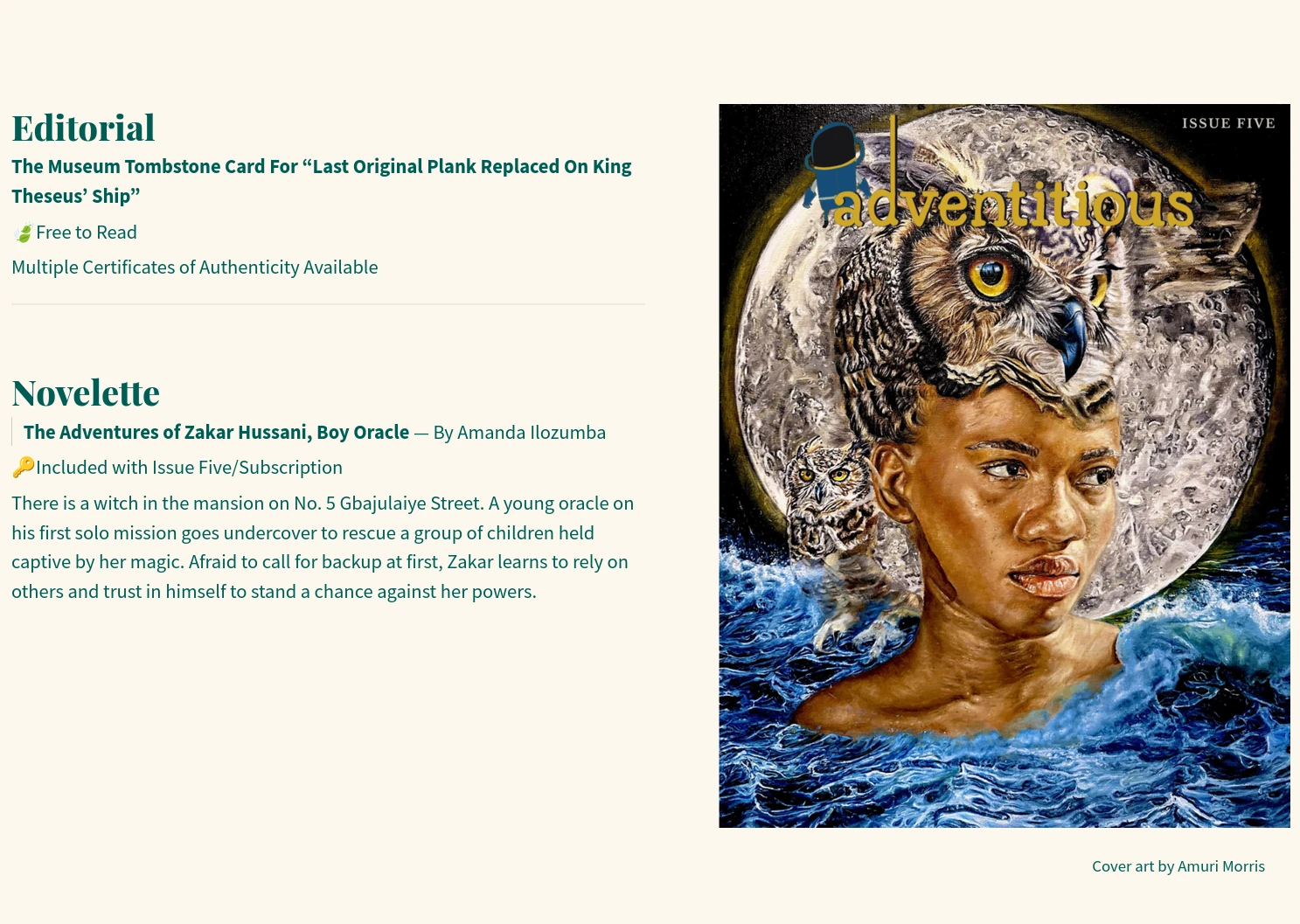
This year, from out of nowhere, a new speculative fiction magazine appeared on the scene with a clear editorial vision:
Adventitious hopes to be an intelligently mischievous literary magazine for the curious and unclassifiable.
Adventitious has lived up to that promise, and more.
Why Adventitious?
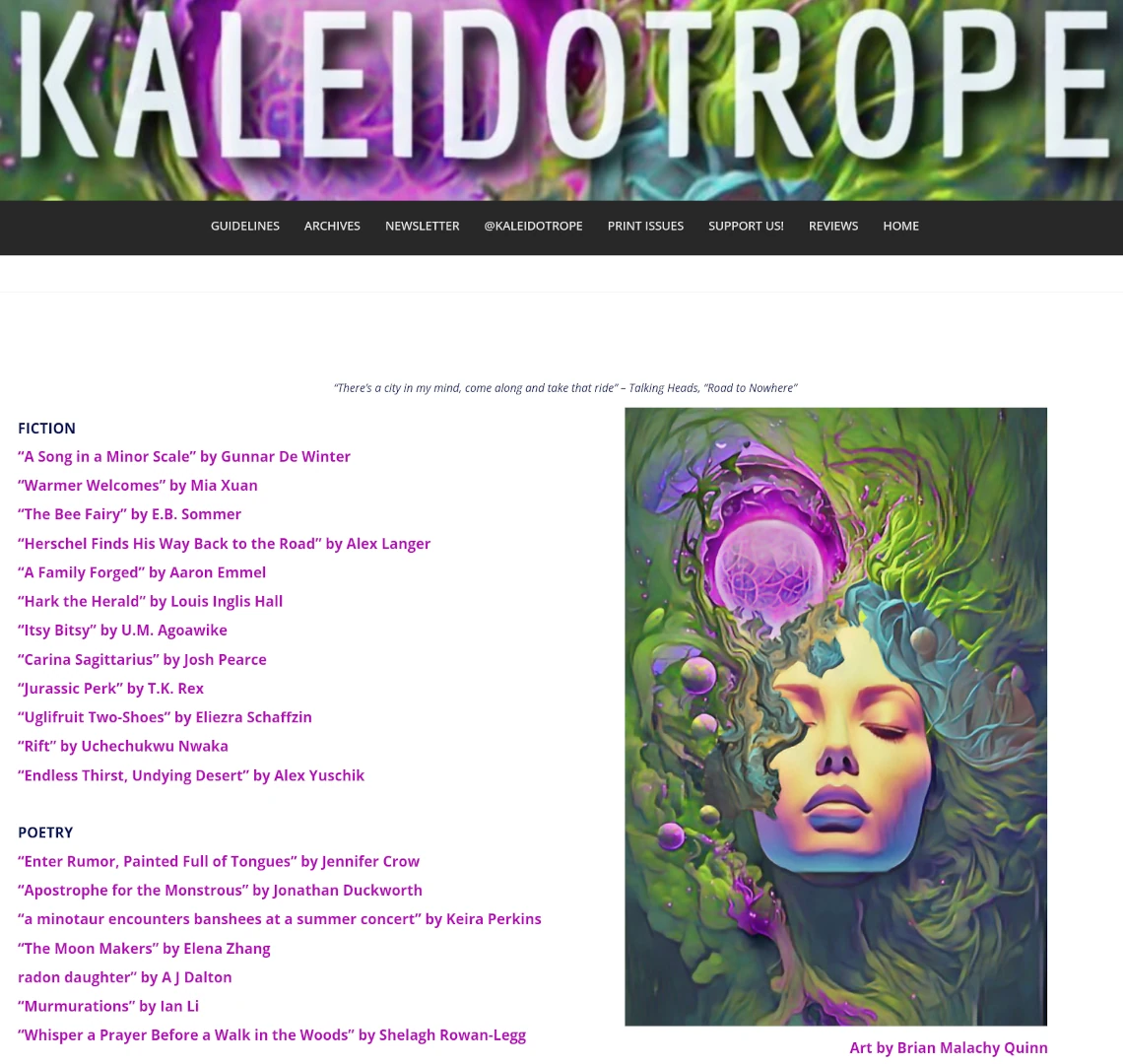
This is my second major recommendation (after Kaleidotrope). When I choose to profile a magazine or publisher here, it is strictly my choice, a volunteer effort on my part. I have put in about ten hours* on this article grand total—not just in writing, but in research—which should tell you how strongly I feel about anything I present on this blog.
But let’s back up a bit, and see how I came to be at this point.
* How do I know the grand total five sentences in? Because for non-fiction articles, I first outline, then fill in details, then polish it up—then go back and write the intro, which is the hardest part.
Bluesky
I think I’ve said it before, but it bears repeating. I had to be dragged kicking and screaming back into social media. Even today, I refuse to have anything to do with Meta, so when I went in, I made finding alternatives my goal.
Last Spring, one of my first finds was the Adventitious account on Bluesky (@adventitiouswords.bsky.social). It took some time, but I tracked down the very first time I saw the magazine mentioned: this post by Katherine Tyndall,* promoting her story “Madam Strzyga’s Pagan Pest Control.”
* That’s the actual post. I scrolled back that far. See? I told you I did a lot of research.
Katherine Tyndall did a trick in her post that was trending, back then: describing her story in emojis. I’d seen a similar post based on Fusion Fragment #27 . (That an issue I particularly enjoyed. It had her story “Digital Love Spell – 78% Effective”) Funny the things that catch your eye, right?
Which brings up one of my major points. It’s the small things. Many authors and publishers go on social media, promote their work, and largely get “oh, that’s nice” likes and scroll-bys. That can certainly be discouraging. But every now and then, your post, giveaway, clever take, quote, review, or other effort hits home and attracts a highly vertical reader like me.
So take heart. We’re out here, looking for the good stuff.
I got issue #2, ended up intrigued, and set myself a lofty goal: to read every issue of Adventitious ever published up to that point. (Meaning: to go back and try out #1 ). I liked it enough to not only write a review on The StoryGraph, but to sign up for the Patreon. I’ve been a member ever since.
It’s pretty easy to try for yourself, but as always with my reviews and recommendations, I’ve written a guide to some of the best stories. You’ll see those later in the article. For now, why not mention …
Free Samples
Yep. Stories in each issue aren’t released to the general public all at once. Those of us on Patreon get them first. (And by direct subscription, as well. Forgot to mention that.)
As each month goes on, more stories are released to the public, which is fortunate—I can take you on a real tour later on.
Eminently Readable
The site design of Adventitious scales well on a number of different screens, including mobile. Further, the appearance is uncluttered, has no page-blocking popups, and is ad-free. (See below on how to keep it that way, eh?)
On the Side of Righteousness
Adventitious has a simple and direct no-AI policy. This is not just for stories; the art is entirely human generated as well.
I also have a no-AI policy. I try to avoid it as much as I can. It’s a real predicament for small press, as their inbox gets stuffed with pretenders. Trouble is, the garbage machines are set on maximum overdrive right now, filling up the entire internet it seems.
So I do have to thank Adventitious for taking a stand and holding the line. Editors are suffering for all of our sakes, which brings up …
Support Small Press
So in the end, why am I writing this? You know as well as I do that the 21st century, so far, is about taking things away from you while pretending to give you more. We can see the consequences of that erosion in the current state of the news media, mediocre and often misleading articles readable for free, credible work hidden behind paywalls and “We’ve noticed you’re using an ad blocker!” garbage. Small wonder. The internet of 2026 is TRASH compared to, say, 2001. Sites didn’t suddenly get more expensive to run, not by the apparent “one jillion percent” you’d think looking at the sheer number of ads that are forced on you; companies just got greedy.
Up against that wall are the small presses, fighting the good fight to keep human civilization at least somewhat worthwhile. The big folks probably try to squeeze and extort everything they can out of each one, when they don’t outright suppress and ignore them.*
Support small press and independent publishers. Find what you love—and do what you can to make sure it’s still there for you when you need it.
* A good example is when Amazon suddenly stopped selling electronic subscriptions to magazines, leaving a lot of markets in the lurch. Here are two articles about that, if you didn’t know: from Fortune and InsideHook.†
† Which accidentally proves another of my points. Of the top five links returned when I researched the Amazon impasse above, the two I listed were the only ones that didn’t flap a popup in my face while I was trying to read.
Selected Works
Hey! I reviewed all five issues, including the one coming out tomorrow. Caveats:
- I limited myself to creating a top three list for each issue.
- The three are NOT in order of greatness, but in the order they appear in the EPUB version.
- I hate spoilers, so I may be vague if I’m trying hard to step around a big reveal (or my own interpretation of the story).
In other words, this list is NOT definitive or objective, just subjective opinion. But that’s OK. This is my blog, after all. So after I’ve got done with my part … go out there and find your own favorites, alright?
Adventitious: Issue One
Time travel: I read Issue #1 after Issue #2. No TARDIS was involved, I was just late to the party.
- Recording of Professor Elizabeth Boucher’s Opening Lecture on Death Ages Novels, University of Presque Isle, March 32, 2667 – Stacie Turner. This story and the next one resonate for me as I was a teacher for 20 years. However, this one story coined a term that I still use today to represent this era—”the Death Ages.” I rank this one high for its realistic back-and-forth with the (unheard) audience and the humor.
- This is Why Magical Realism and Family Tree School Projects Shouldn’t Mix – Abigail Guerrero. Oh, man. The stories I could tell you about school projects. Once upon a time I taught sixth graders about genotypes and phenotypes using the ABO blood groups. One kid (sorry if you’re reading this, but you’re 32 years old now, so you can probably take it) asked me the question “So if my parents are both type O, how am I type A?” To which I replied: well, you know, random mutations occur all the time. (Not an answer, but still true.) So, yeah, I can see myself a bit in this story, on both sides of the equation.
- The Soundtrack of My Afterlife – P.A. Cornell. By now, surely you’ve heard of this story, by one of my new favorite authors (I recently read The Astronaut Among the Flowers, a collection of her short stories, just based on her recent magazine work.) I will admit: going into this story, I was very skeptical. One of the TV series regarded as the worst of all time is “My Mother the Car” (NBC, 1965 – 1966), and this was in a similar vein. But … no! As I read, this story developed a serious beating heart and a textural vibe built on the music that appears in the story. By the end, I knew I had just finished reading an all-time favorite.
Adventitious: Issue Two
This is the issue I read first. Part of my reason for choosing these stories was, looking back months later, I was able to remember most of the plot and key ideas just from the title. One story on this list does very well at that.
- Madam Strzyga’s Pagan Pest Control – Katharine Tyndall. Here’s one where I have to dodge around spoilers, but I have to admit … if you know what a Strzyga is, and add it to the concept of Pest Control, you may be heading in the right direction. (Interestingly, the same name seems to occur regions other than Poland, with different interpretations. Strega Ital. “Witch”, for example.)
- Fractal House – Merc Fenn Wolfmoor. Well, here it is. Of all the stories in Adventitious, this is the one I remember the best and usually cite as an example when I’m talking about the magazine. I do love horror, especially the type of story where the tension exists because we KNOW someone is making a stupid decision, sprinting down the tunnel to the worst possible outcome. This story is a “found footage” tale with an interesting twist: the footage apparently will never go away. (Interestingly, the author put together an entire anthology of found footage type fiction on Backerkit, [RECORDED].)
- The Place of Oblation – Debora L. Davitt. Hint going in? This is a story of alien archaeology, but depends in principle on the word Oblation, “an offering.” I can’t say more, but this one … had a lot of meaning, for me. I’ve been to those ruins many times before.
Adventitious: Issue Three
One of the things I like best about Adventitious is that it’s a place I can find stories that have humor. I have no idea why, but in this world where absolutely terrible news drops every fifteen minutes, you’d figure people would want a tiny bit of escape from things that are grim. So here we go!
- Who Tells Your Story? – Clint Hannah-Lopez. And welcome it was. You can’t tell from the website, but this is the first story that appears in the EPUB version. It was a great way to begin, clever and funny, with a perfect last line, this is an … almost fairy tale?
- The God of the Leftmost Door – M.R. Robinson. Though this is set in the afterlife, it reminded me of mythologies involving spirits dedicated to a particular object, place, or action. Roman mythology is full of them, for example, Janus, the god of doorways. Well … here’s a spirit dedicated to the leftmost doorway. There are two levels to this story, first the humans passing through, then the resident spirits themselves.
- Kings_Gambit.exe – Yelena Crane. I was going to make a joke here that this is a horror story, because it’s clearly a future in which personalities can be recreated in a computer but 1) it obviously runs on Windows [the .exe filename] and 2) the code looks like Java.* At any rate, the personalities recreated here are chess champions … forced to play chess over and over again.
* Not strictly true. One bit of code tests for string equality using ‘==’, which in Java would only be reference equality. In my dream world, this would be Perl. Probably it’s C++, which is tragic in its own way if this is set in the far future.
Adventitious: Issue Four
There is a recommendation on this list that has its own, entire backstory. Instead of rehashing it, I’ll direct you to P.A. Cornell’s blog where she discussed the long journey* “A Game of Go” took from its original sale market to publication here in Adventitious.
* Something like the Odyssey, or maybe even theodicy. Certainly she had to deal with “the idiocy.”
- A Game of Go – P.A. Cornell. A long time ago, I played Go, a game that has very simple rules but very complex play. This story uses the different moves and strategies in Go as a scaffold, but you absolutely do not have to know how to play to understand the story.
- How to Lose to Death – Priya Sridhar. Another story with some humor, in the unusual form of a list. I do wonder what Death’s favorite shots are. (I’m going to place a bet on Brennivin.)
- Saul & Noah’s Hot Bouleutophagy Summer – Elijah J. Mears. This title really confused me at first. I knew the root words –phagy (eating of) and guessed a derivative of boletus (mushroom) for the first part. Wrong! Little did I know that the Fiendish Doctor Internet had invented a new word based on the Greek bouleutés (politician). You can probably do the addition from this point and see where this story is going.
Adventitious: Issue Five
If I timed this right, the new issue of Adventitious will land tomorrow, 1-October-2026. Most of the stories recommended below won’t be on public view for a while. But you know what? You can subscribe or buy the issue. (It’s even available on Weightless Books.)
- How to Understand Each Other – Emmie Christie. A think that I like to find are stories that are new, but read like fables. This one? It starts off in a strange place, but as you read, the details filter in, until suddenly you understand what the fable is all about.
- The Gorilla Fighters Under Texas, or: Derek King, Age 8, Shares His Take on the Salvadoran Civil War With Classmates at Sam Houston Elementary Based on a Viewing of ABC World News Tonight with Peter Jennings on January 19, 1988 (Confederate Heroes Day) – Chris Baker. Normally I get by with a few seriously obscure references, but today I’m going for the record. This story reminded me of the old Dirk McGirk stories that appeared in Crazy magazine from time to time. (Sadly, I can’t find scans of any of those to share, but they were just as hilarious as this story.)
- New Game Plus – Abhijeet Sathe. Maybe it’s a sign of the times, but a whole lot of stories lately seem to focus on the afterlife. This one, though: there might be a cognitive barrier for some older readers to overcome. If you’ve played video games before, just skip over what I’m about to say to the dal segno mark (𝄋). Some video games are like stories, and as you play through them, your character may even earn points for upgrades along the way, getting stronger with time. Once the story is over, then what? For additional challenge, there might be an option called New Game+, which lets you start the story over—but in a harder mode, using the upgraded character. Anyway: 𝄋 Some of us who play games like to get stuck in the character design screen for a few hours before even starting. Then we play for a while, dislike our build, think of something better, and start over again anyway. (Don’t hate. That’s how I ended up being my favorite character of all time, FemShep from Mass Effect.) Well, now that I’ve given you all this background, extrapolate: what if the afterlife was something like the character design screen?
Intelligence File
Adventitious, being brand new, has a number of hills to climb, friend of friends. First is getting word out about it. Most small press editors have another job, so have to squeeze in promotions between their other obligations. Fans can help get the word out there, and I hope, once you try the magazine, that will include you.
For Readers
What the—? Oh, the indignity. All of these great stories, and never nominated for a Hugo award. Wait. This just in …
Oh, right. They just started in 2026.
Let’s get them on the ballot next year, eh? It’s about time for new contenders to step into the ring. I think there’s enough award-worthy material in here to break through.
Reviews? Well, Adventitious has a few listed, but even Locus has only reviewed them twice, as of this writing. Even if you can’t subscribe, you can still help by getting the word out there.
For Authors
In my own writing work, I’ve aggregated data for 93 fiction markets* that I’m interested in submitting to. (Sources: Duotrope, The Submission Grinder, Chill Subs.†) The stats below were current as of 28-Sept-2026.
* Not counting submission calls for anthologies. I have about 20 of those listed, all the way out to Feb 2027.
† Chill Subs has no worthwhile data for Adventitious. Puzzling. Not uncommon, but puzzling.
- Favorite Factor: 195, comparable to DreamForge among author follows and submissions. (Rank 53 out of 93).
- Acceptance Rate: 7.51%, comparable to Tales to Terrify. (Rank 65 out of 77 in terms of difficulty, e.g. Interzone is at 1 out of 97 with a rate of 0.15%.) Caution! This stat is misleading, see below.)
- Lag: 17.0 days, comparable to Fusion Fragment (Rank 23 out of 97 in terms of getting responses back to authors, so in the top 25%).
- Submissions: One of the few SF/F/H markets on Duosoma (as opposed to Moksha or Submittable).
A Warning About Acceptance Percentages
The math on those just doesn’t work out. Every time submissions are open, there’s usually a cap, currently at 300. Bimonthly issues of adventitious have averaged 12.75 stories each. Dividing 12.75 / 300 gives us 4.25%, not the stated 7.51%.
A lot of assumptions are in play here, the first being total knowledge. Nope. These stats come from voluntary reporting of submissions and from completed reports. Only people savvy enough to log submissions end up being counted.
Plus, limiting the pool to 300 has traditionally resulted in the cap only lasting a few hours. Chances are, the ones waiting at the gates, story in hand, were the serious writers. (Goofballs turning in AI slop, I’d guess, just spam off a hundred submissions at every open market as soon as they’re finished turning out the latest batch, like virus particles exploding out of infected cells.)
That’s It! And Disclaimers
Well, you’ve survived another one. (Assuming you got this far. If you’re not reading this, disregard.)
Opinions presented here are entirely my own. Hopefully I provided proper attribution / links to everything I cited in the article; if I didn’t, please let me know and I’ll correct this post. At any rate, just because I linked somewhere, it doesn’t mean they had any input into this article. The words and opinions are all mine.
One idea that spans religions is “do unto others as you’d have them do unto you.” I don’t take tips or collect names for an email list. I made sure my site wouldn’t be the kind of place where you start reading, and five seconds later some screen-obstructing garbage pops up to pester you with something. If you appreciate my work, try donating to one of the following charities. Each of these has very personal meaning for me.
- The Trevor Project. One day, one day I will tell this story. I am missing a family member who could really have used their help, but help wasn’t coming. If only she had reached out to us.
- The world is really crap right now, right? Pick one:
Failing that, well, money isn’t everything. I personally think the unemployment rate is a lot higher than they say—they’re cooking the numbers to make it look like the economy isn’t in false vacuum. Support each other in other ways. The billionaires want you sedated, divided, numbed, submissive. Even Neanderthals took care of the weakest members of their society. Do better.