
Category: Atla

  • The World of Atla

    A story told in seven maps.

    In a previous post, I introduced the Cerulean language, spoken by the peoples of the Kalenesyan Archipelago in one of my fantasy settings, the world of Atla.

    Today I’d like to take you there.

    Let’s just start off running, then I’ll talk about how I created these maps toward the end.

    1: The Cormeideon Empire
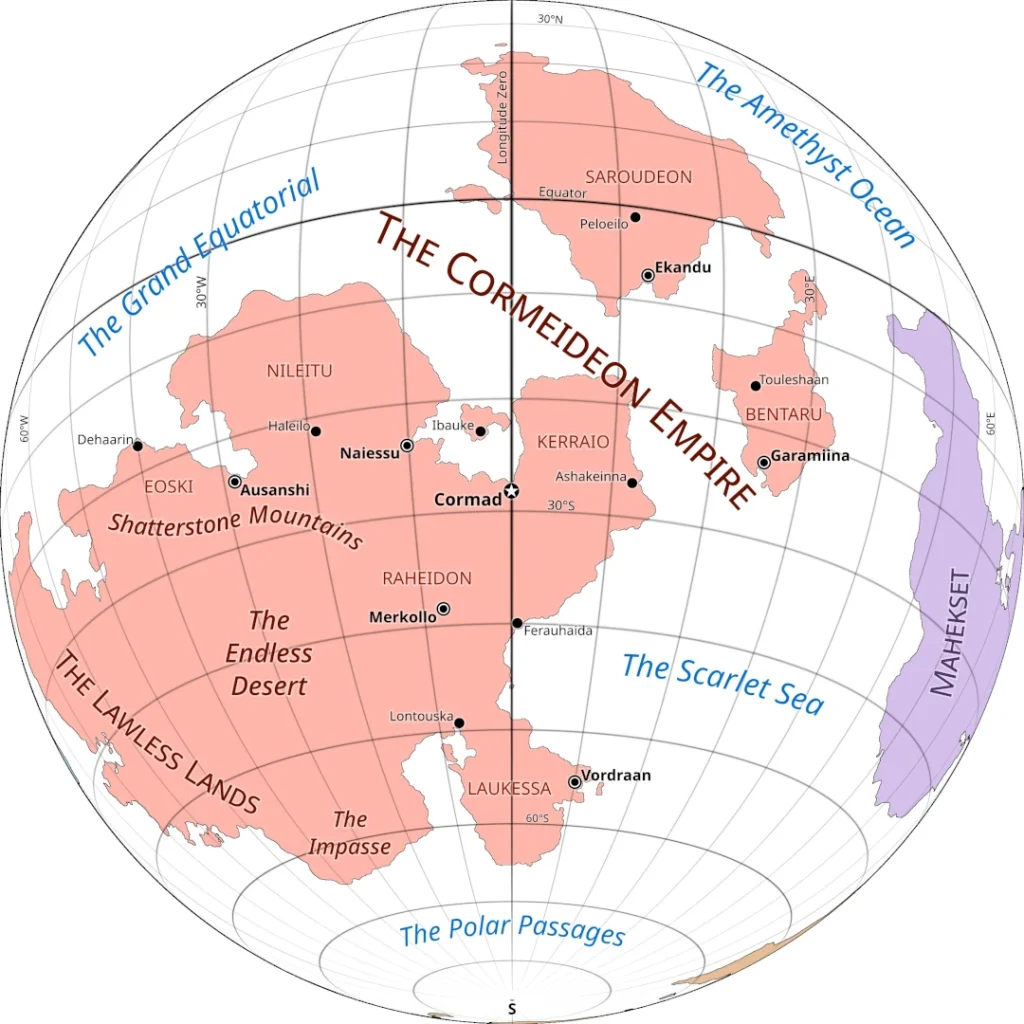
    A map of Atla, one of my fantasy settings. This map is a spherical projection centered on Latitude 30°S, Longitude Zero. This centers the view over the eastern part of the Scarlet Continent, showing the Cormeideon Empire and its two main island territories.
    Atla, seen from above (30°S, 0°).

    The Cormeideon Empire gets its name from the Amethyst language K.R.M.E.DH, five glyphs pronounced /ka.ra.meː.ða/ (“Karamedha”), or Scarlet.

    It’s not really an Empire, and hasn’t been in a thousand years. They’re just very slow in changing traditional names.

    In fact, Cormad considers itself a meritocracy; through extensive testing, the community chooses the profession that best suits you. Some disagree with that, but the fact is, this is the most powerful nation on Atla, and it doesn’t really tolerate argument about its internal affairs.

    2: The Lawless Lands
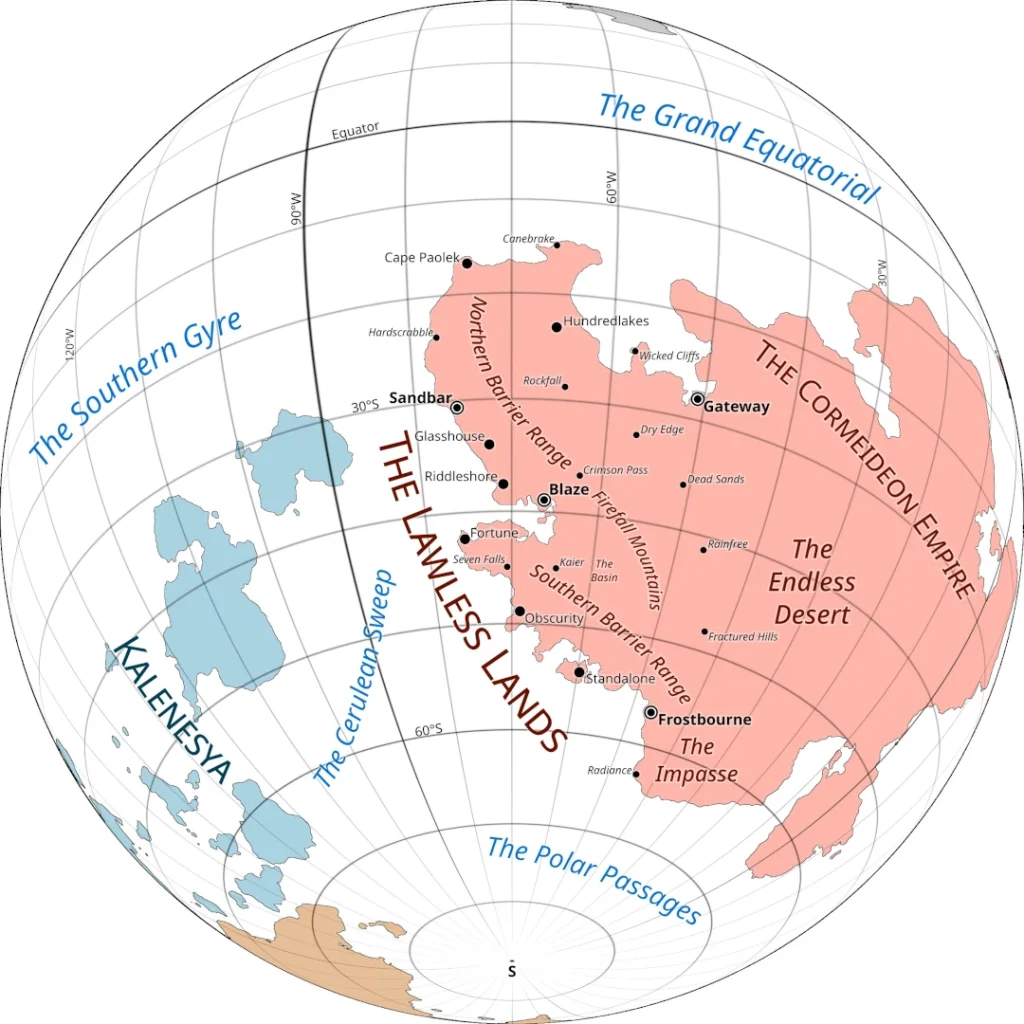
    A map of Atla, one of my fantasy settings. This map is a spherical projection centered on Latitude 40°S, Longitude 70°W. This centers the view over the western part of the Scarlet Continent, showing the Lawless Lands in relation to the Kalenesyan Archipelago.
    Atla, seen from above (40°S, 70°W).

    Ask someone from the Cormeideon Empire for the name of this place, and they’ll call it The Western Provinces. That hasn’t been true for hundreds of years (but like I said: slow to change).

    A network of fiercely independent city-states, the Lawless Lands is lawless only in the sense that “none may govern or command us.” That sounds wonderful, until you realize many of the cities are governed by powerful, conniving, aggressive, and ambitious leaders.

    3: The Kalenesyan Archipelago
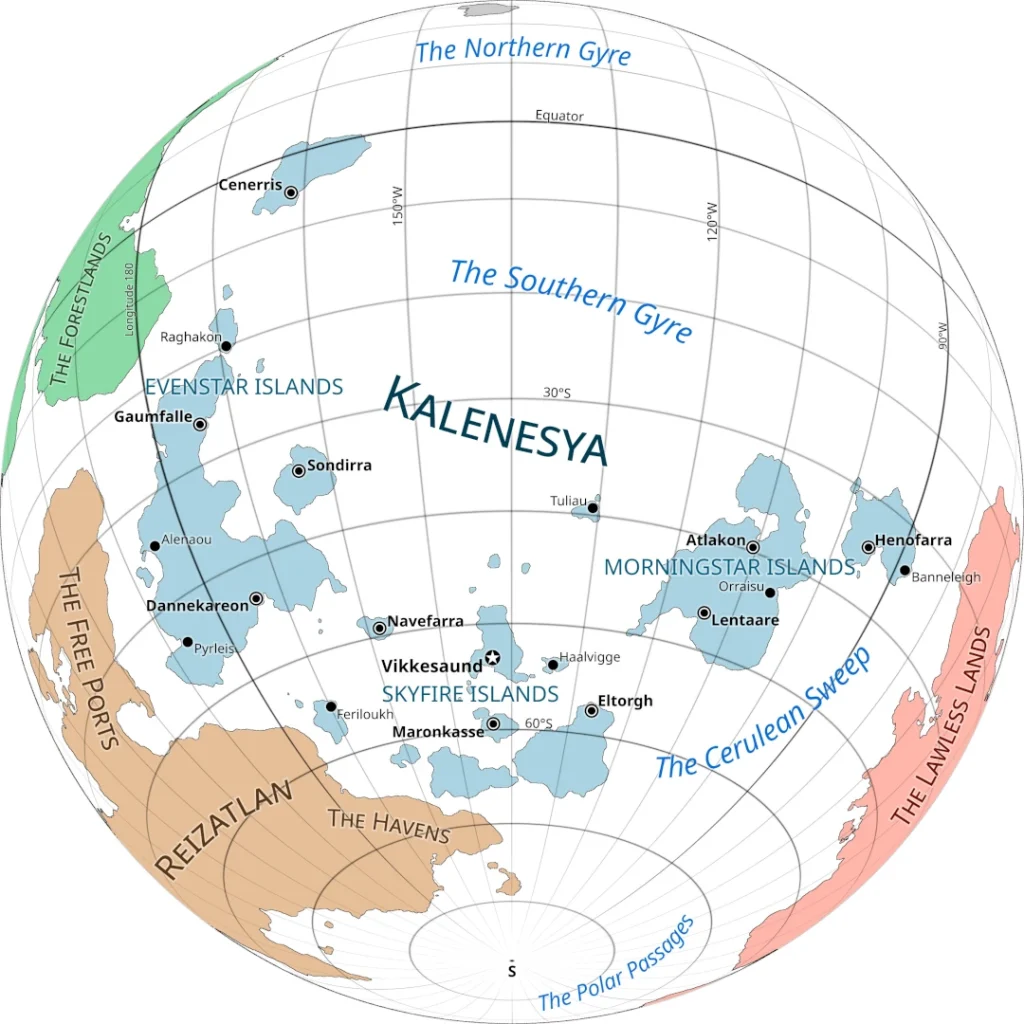
    A map of Atla, one of my fantasy settings. This map is a spherical projection centered on Latitude 40°S, Longitude 140°W. This centers the view over the vast Kalenesyan Archipelago and its three main island groups: Morningstar, Skyfire, and Evenstar.
    Atla, seen from above (40°S, 140°W).

    In the old days, the sparsely inhabited Kalenesyan archipelago was home to pirates, renegades, failed revolutionaries, the dispossessed, and in the end, people fleeing tyrrany. For a while the old ways persisted, with a dozen Great Houses fighting endless battles with each other for trade and resources.

    Then, while they were distracted and weak, every nation around them attacked. The choice was unite or die, and thus today we have All Fleets Unified.

    4: Reizatlan
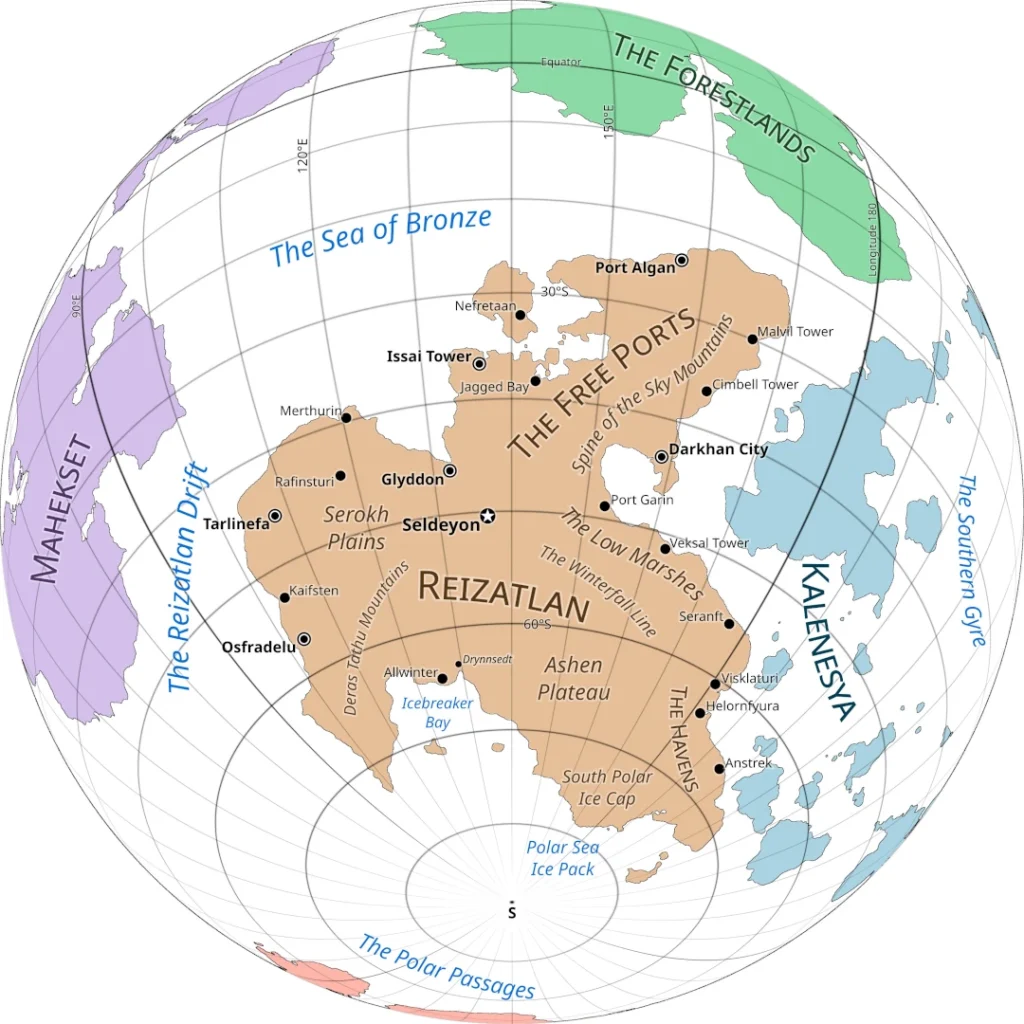
    A map of Atla, one of my fantasy settings. This map is a spherical projection centered on Latitude 50°S, Longitude 140°E. This centers the view over the Bronze Continent, sometimes called Reizatlan ("The Old World").
    Atla, seen from above (50°S, 140°E).

    Reizatlan proper is a long-settled land of impressive nobility and quiet desperation, a society with an entrenched feudal system, caste system, and bureaucracy. This has led to a large number of rebellions and breakaway regions, so much so that only the Serokh Plains hold on to all the Old Ways. (Notably, they are on the opposite coast from the traders of Kalenesya and the wealth of the Forestlands, facing the isolationist nation of Mahekset—thus they’ve escaped a lot of modernizing influences.)

    5: The Forestlands
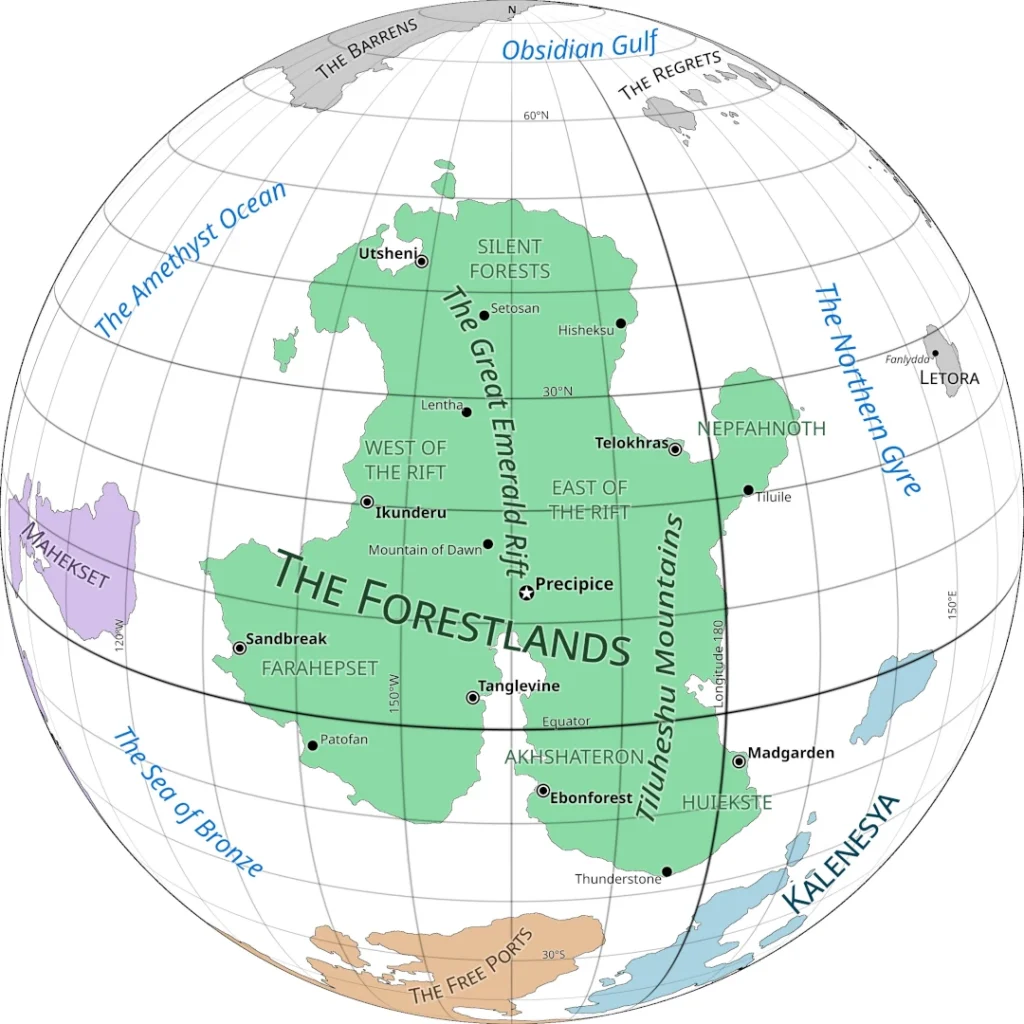
    A map of Atla, one of my fantasy settings. This map is a spherical projection centered on Latitude 20°N, Longitude 160°E. This centers the view over the immensely fertile and resource-rich Emerald Continent, also called the Forestlands.
    Atla, seen from above (20°N, 160°E).

    If one were looking for a place for the next Land Grab War or global conflict to start, it would be the madly fertile cliffs and valleys of the Forestlands and the rich mineral deposits of the volcanic ranges.

    Every nation on Atla vies for influence there, but there’s one important factor to consider: the native population is far from helpless. Four out of every nine Forestlanders is born deaf. Over time, they developed a language that switches effortlessly between speech and sign. No invading army has ever prevailed against them on their home territory; instead, enemies find only sudden, silent death.

    6: Mahekset
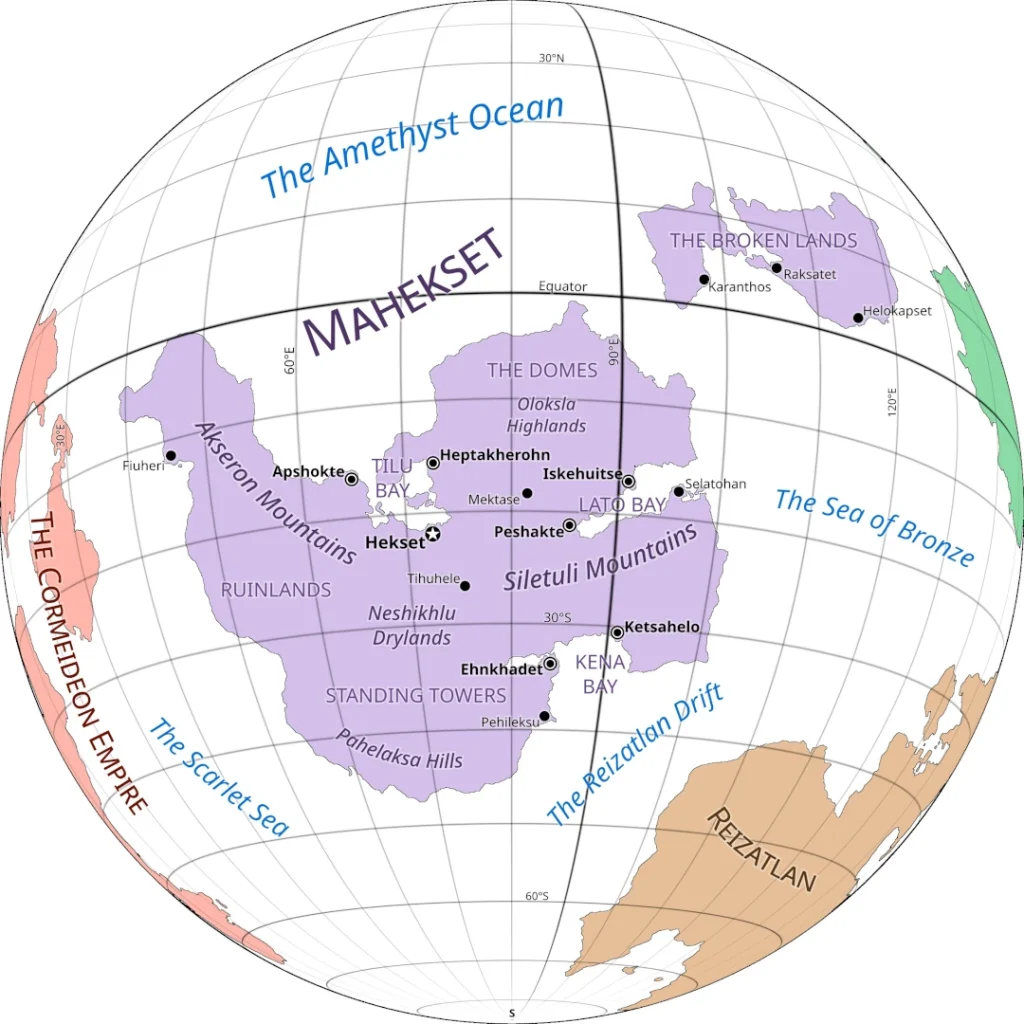
    A map of Atla, one of my fantasy settings. This map is a spherical projection centered on Latitude 20°S, Longitude 80°E. This centers the view over the Amethyst Continent, home to the powerful yet insular nation of Mahekset.
    Atla, seen from above (20°S, 80°E).

    The Amethyst Continent was once home to the Masters, also known as the Ramatlan, beings who claimed to have created the human race as servants. After the Third Rebellion, they fled through World Gates to other realms.

    The Hekat people hail from the Silent Forests of the Emerald Continent. A careful, contemplative people, they eventually worked out a lot of the magic, alchemy, and technology left behind by the Masters, and guard that knowledge fiercely.

    A strict matriarchy, women are in charge of all government and political systems, while men control the military.

    7: The Northlands
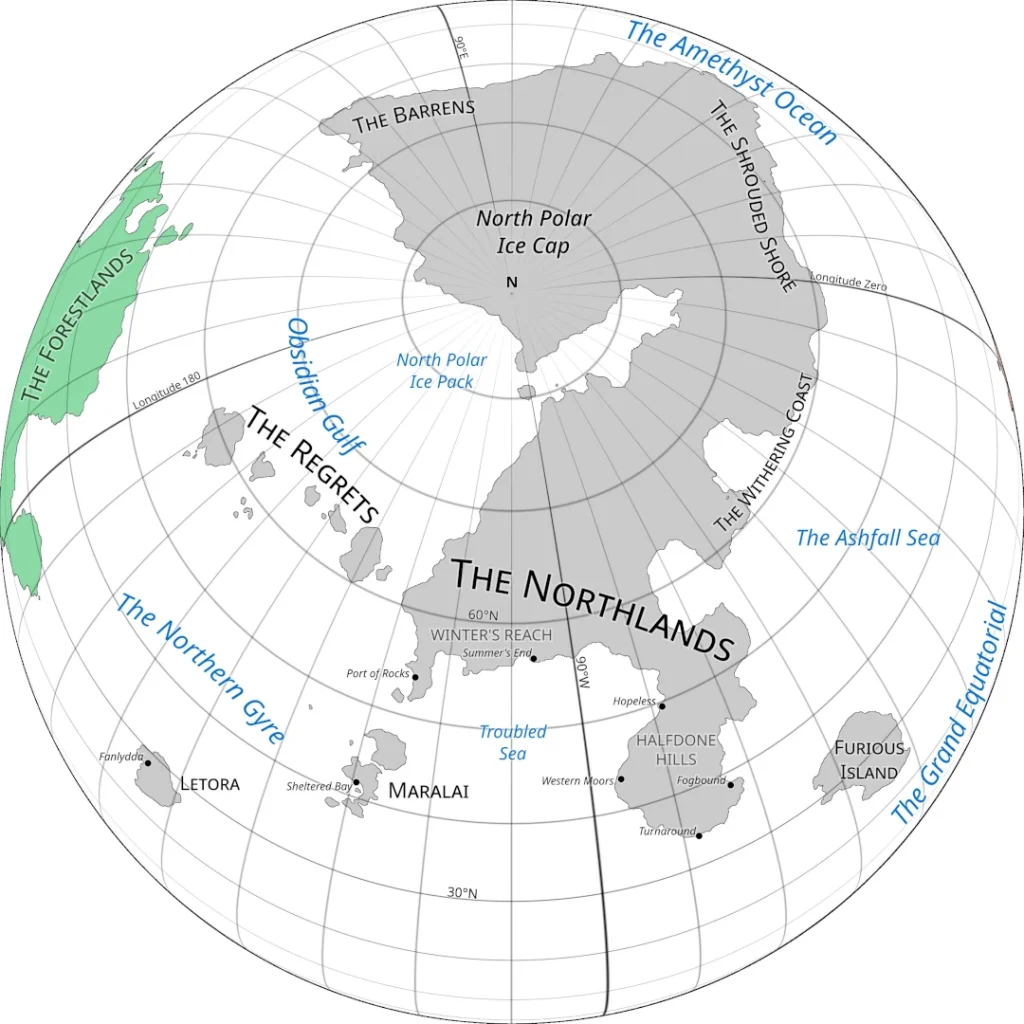
    A map of Atla, one of my fantasy settings. This map is a spherical projection centered on Latitude 70°N, Longitude 100°W. This centers the view over the barren and fearsome Northlands, sometimes called the Obsidian Continent.
    Atla, seen from above (70°N, 100°W).

    In combination with its remote location, the worst weather on Atla prevented exploration of the Northlands until four centuries ago, when the first reliable three-masted ships and global navigation techniques were developed.

    The Northlands are mostly barren and hostile, with intensely active volcanoes and frequent earthquakes. Cities on the coast suffer not just from intense storms, but from the occasional tsunami.

    Interestingly, just a few decades back, someone discovered enormous coal deposits there … as well as a strange, tarry substance the alchemists at the All Fleets Academy dubbed “Petroleum.”

    Surely that will remain just a quiet curiosity.

    About the Maps

    Maps are Moments in Time

    Atla has a very long history, going back hundreds of thousands of years. Human civilization has been around for 5000 to 9000 years (it’s complicated). This world is not static; things change. Therefore this map is a snapshot of Atla at one stage in its development.

    For one thing, the Kalenesyans have united to become All Fleets Unified, and are becoming the dominant force for global trade in the world. Therefore, this map is labeled in the Cerulean language (you’d see different labels if this map were from Mahekset).

    Further, everyone would have a different opinion as to what to call the year this map was made:

    • The All Fleets Academy (who made this map) would say it’s the year 242 Unified.
    • They’d grudgingly admit that Imperial historians might call this the year 4020 Standard.
    • The Masters (if they were still around) would say this is the 3331st year of the 25th Maralika, or the Ordinal Year by Atlan Reckoning 113,923.

    How These Were Created

    Every time I show these maps, someone comments that they must have taken a lot of work. They did, but I chose my tools wisely:

    1. Wonderdraft to generate many, many continental shapes and landforms.
    2. The GNU Image Program* to edit the equirectangular basis maps, then project these onto a sphere.
    3. Inkscape to add the labels in a way that they are easy to edit.

    * The GNU Image Program has a name that can be considered (and is) a slur. I don’t use that word; neither can I provide a direct link.

    I’ve created maps like these a lot over the years, so to me, this is all an established method. In fact, my first accepted story, “The Good that Demons Do,” takes place on a different world, Taián.

    Stick around. One day I’ll take you on a tour there, as well.

  • Conlangs and the Art of Nomenclature

    Constructed languages can add depth to fictional worlds (as Tolkien would agree). Learn to pronounce names in the Cerulean language with the help of the International Phonetic Alphabet.*

    * If your browser doesn’t do Unicode, you might see some strange results here. Just pretend those letters got hit by cosmic rays and mutated.

    People who have beta-read my stories and (unpublished) novels usually comment on the nomenclature, the naming of people, places, and ideas. I suppose this is by contrast. There are an astonishing number of popular books out there where the author just went in and “wrote something that looked alien” or “came up with a fantasy name.” Here are some BAD examples:

    • Keyboard-fu names such as Stndsfrtg, apparently created by button-mashing or scrabble-tiling a few characters together. (Looking at you, Phantom Girl from the planet “Bgtzl.”)
    • Apostrophe-fu, where Ever’yone H’as an A’postrophe.
    • Unicode-fu, where we break out the special characters (especially the German ones, which look cool): Bühánnèk, Rålbjênng.

    In contrast, one of my novels features characters named Tounbaris Deorgh, Margalle Renhaaleon, and Saamet Keldorra. Whether your conscious mind realizes it or not, these share an internal consistency. If I asked which of these two names belongs to a fourth character—A) Naori Benaatrazin or B) K’ronk Gälbklot—most people would immediately recognize that (A) shares features with the existing set. (On the other hand, if oddball K’ronk ever shows up, it would be clear he didn’t belong, which can be an important clue as well. You’ll see an example of that later.)

    The thing is … one can take a guess at how to pronounce Tounbaris without knowing the rules. Deorgh is trickier, but in the end, it doesn’t matter. These names are in Western / Trade / the Cerulean language (a conlang), and since they belong to people of the sea, it is to be expected that there will be regional variations.

    However, I could tell you more …

    • Tounbaris /tuːn.ˈbɑr.ɪs/ “Bell Ringer” is a fortunate name for sea folk, as it means the turn of the hourglass and represents hope for the future.
    • Deorgh /dɛ.ˈoʁ/ “South” tells us his people came from the cooler lands down south. We might also call him Toun the Southerner. (By the way, that /ʁ/ is the famous “French R”, not the /r/ from Spanish or the /ɹ/ from English. Islanders spell it using the glyphs for R + GG when it occurs at the end of a word.)

    Now, some magic happened between those / / marks above. That’s called the International Phonetic Alphabet. (I use it a lot, so much I wrote a few Python scripts to make typing it in easier.) Once you know how to use it, it not only makes learning a new language easier, it makes constructing languages more consistent as well.

    But I had additional help—The Language Construction Kit. (Available as a free website, but I have the book, which is more detailed.) Beyond that, I had experience: over the years, I’ve studied Spanish, French, German, Latin, and Japanese as well.* Accidentally, I became an amateur linguist; from there it was a very short path to creating my own languages.

    * Studied: does NOT imply I can speak these language fluently. I can read the first, guess at the next three, and identify a few minor features in the last.

    Follow me for a short while. I’m going to teach you to talk like an Islander. By example!

    Vowels

    You may have noticed only certain combinations of vowels occur in the names above. That’s because there are only ten possibilities. Unlike in English, they only ever have one possible spelling.

    • Short vowels a /a/, e /ɛ/, i /ɪ/, o /o/, and u /ʊ/. You can simulate these in English with “bat, bet, bit, boat, book.”
    • Long vowels such as aa /aː/, ei /eː/, ii /iː/, au /ɔː/, and ou /uː/. The only odd one there is the “au” as in “caught” (which might be different for you, depending on your dialect of English). Also, this is the Spanish / French / German / basically every language except English /i/ sound as in “bee.”
    • There are also a few diphthongs, ai as in “Hi!”, aou as in “How?”, iou as in “Hue”, and eiy as in “Hey!”
    • There’s one more vowel sound, /ə/, which we will meet below in special circumstances.

    The Sound of Cerulean

    Though I never state these rules in any story I write, they’re present, and determine what a valid word looks and sounds like. Now we come to the examples! All of these are proper names.

    Doubled consonant + E

    If e occurs in the situation above, it takes the sound /ə/ (“uh”, the Schwa sound); the consonant is pronounced in both syllables.

    • Mol /mol/, but Molle /ˈmol.lə/
    • Hanesa /hɑ.ˈnɛ.sə/, but Hanneskeiyn /hɑn.nəs.ˈkeɪn/

    Final E or A

    At the end of a word, final e or a are always pronounced /ə/. If there are two preceding consonants, they always get split between syllables.

    • Hanesa /hɑ.ˈnɛ.sə/
    • Temre /ˈtɛm.rə/

    This excludes single consonants that are represented as a digraph, e.g. sh = /ʃ/:

    • Cortaashe /kor.ˈtɑː.ʃə/, but NOT /kor.ˈtɑːs.hə/*

    * Which brings up an interesting issue. Cerulean writes our “SH” sound as a single glyph. Just like the other letters, it can be doubled. Fortunately, words like Lashshe /ˈlɑʃ.ʃə/ are rare, and when written in a story, would probably just be Anglicised to Lashe. (You do have to think of these intersections and exceptions when you’re designing a language.)

    Final I or U

    In contrast to the rule above, the short vowels i or u at the end of a word become /i/ and /u/. (Note these are NOT the same as the long vowels ii /iː/ and ou /uː/.)

    • Silatouri /sɪ.lɑ.ˈtuː.ri/
    • Farradainu /fɑr.rɑ.ˈdɑɪ.nu/

    Test Your Transliteration Skills!

    Below are five common names from Earth. Assuming the consonants are the same, translate these into the form they would appear in Cerulean. There may be more than one correct answer, but warning: some of these names may be impossible to carry over without an alteration.

    1. Daisy
    2. Dianne
    3. Delia
    4. Doug
    5. Doyle

    (Answers)

    1. Daisy → Deizi, Deiysi, etc. Here the “ai” in English is NOT pronounced like the ai /ɑɪ/ of Cerulean, but instead like ei.
    2. Dianne → Dayan or Daian. Notice that “Diana” would be Dayanne (and is more likely to be a real Islander name).
    3. Delia → Diliya. Shortening it to Dilia would make it read more like “Dilya”, and since the letter combination “ia” occurs so rarely, an Islander might choose that spelling instead.
    4. Oof. Tough one. There’s no “u as in but” sound, /ʌ/. I hate to say poor old Doug might be Dog in Cerulean, but … maybe Daug? (Ironically, the second one is pronounced similar to “dog.”)
    5. Cerulean doesn’t have an “oy” diphthong. They could simulate it with Doyle → Doyel, but it would read more like “doe-yell.”

    Did you notice … ?

    All of these names look foreign. One might expect Gaumfalle, Saisherra, and Nadraglein, but “Deizi” doesn’t seem to fit, even though it doesn’t break any rules.

    That’s the power of creating a language behind the scenes.

    That’s It! And Disclaimers

    A relatively short one, today. As this blog goes on, I plan to put more articles on here about my writing, world building, and other topics such as realistic science in speculative fiction. Meanwhile …

    Opinions presented here are entirely my own. Hopefully I provided proper attribution / links to everything I cited in the article; if I didn’t, please let me know and I’ll correct this post. At any rate, just because I linked somewhere, it doesn’t mean they had any input into this article. The words and opinions are all mine.

    Like my blog? Great! I don’t collect emails or tips. Do me a solid and donate to The Trevor Project. I was a teacher for twenty years, and I know there were times that the one kind word I said made all the difference.

    It’s a travesty the world has gotten as terrible as it has, and I wish doing my job hadn’t become impossible to bear.

    One day I’ll have to write about that, too.